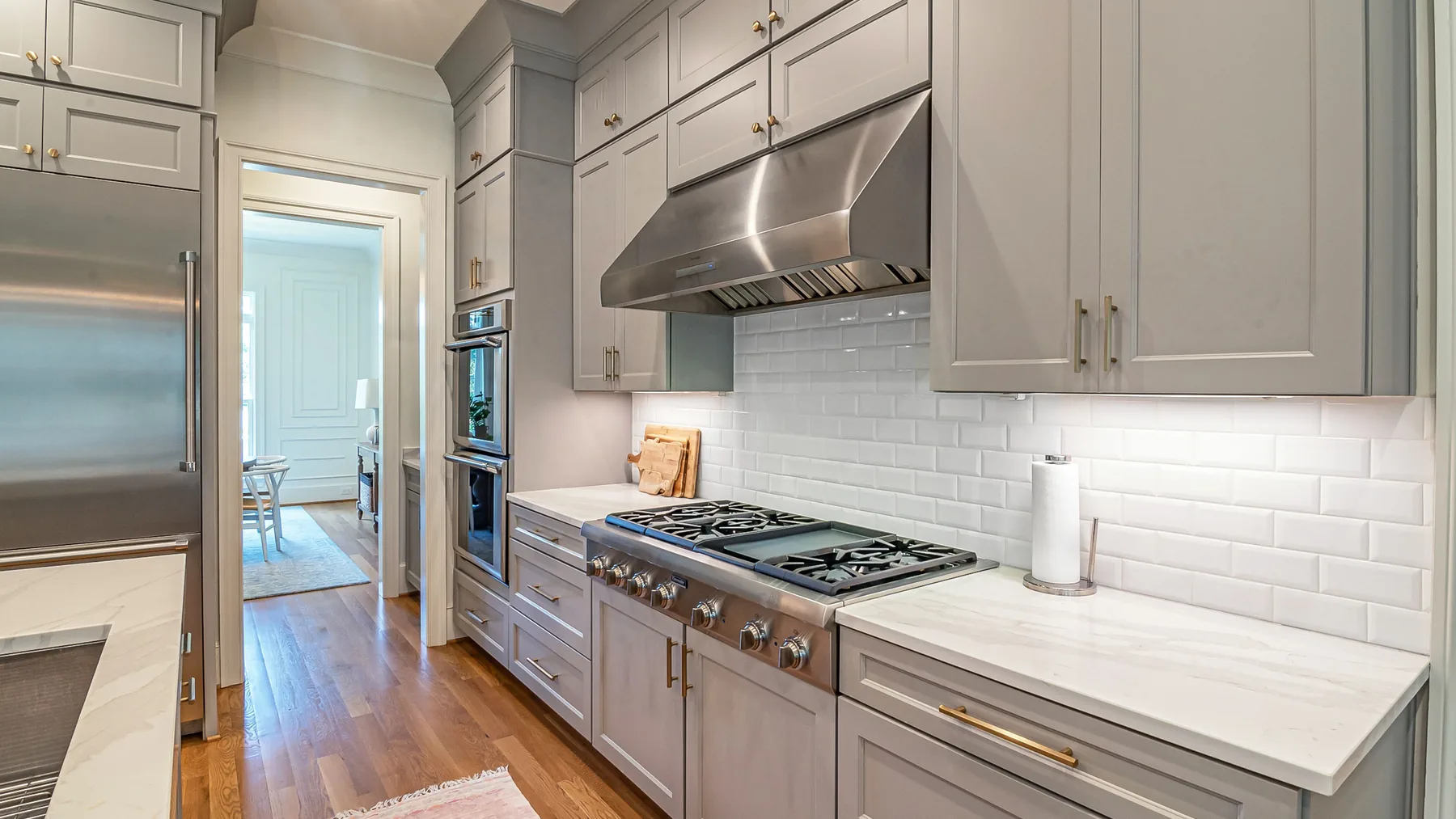
Walk through any newly renovated kitchen in Greenville's nicer neighborhoods and you will spot the same move again and again: cabinets in two colors instead of one. Two-tone kitchens have become the default request in the Upstate, and for good reason, since a well-chosen contrast adds depth, defines the island, and makes a custom kitchen feel designed rather than assembled. But two-tone is easy to get wrong, and the wrong pairing looks less like a statement and more like a mismatch. Here is how to do it well in a Greenville home, and what the second color actually costs.
Single-color kitchens can feel flat, especially the sea of all-white that dominated the last decade. Adding a second tone breaks up the space and gives the eye somewhere to land. In Greenville's mix of older Augusta Road homes and new construction out toward Five Forks and Simpsonville, two-tone also solves a practical problem: it lets a homeowner keep bright, airy perimeter cabinets while grounding the room with a richer island. The look works across traditional and transitional styles, which is most of what we build here.
The combinations that endure share a formula: one neutral, one anchor. White or soft greige perimeter cabinets paired with a navy, forest, or natural-wood island is the Upstate workhorse, flattering in both a downtown bungalow and a Greer new-build. Warm woods like walnut or rift oak on the island have surged because they add texture without shouting. The pairings to approach carefully are two saturated colors at once, which can fight each other, and anything tied to a single trend season. Anchor one tone in neutral and the kitchen stays timeless.
Placement is what separates a designed two-tone kitchen from a confusing one. The island is the natural home for the accent tone because it is a distinct object in the room. Other smart spots are a run of tall pantry cabinets, the base cabinets under a contrasting upper set, or a hood surround. The rule of thumb is to give the second color a clear job rather than scattering it. A cohesive Greenville kitchen reads as two intentional zones, not a patchwork.
The most common question is whether two colors doubles the price. It does not. The added cost comes from running a second finish batch, masking, and the extra handling, which adds a modest premium rather than a second kitchen's worth of expense. On a Greenville custom project it typically lands as a small percentage of the overall investment, and homeowners who choose a stained-wood island over a painted one sometimes find the material cost, not the two-tone itself, is the bigger line. Get a clear quote that separates finish cost from cabinetry so you can see exactly what the contrast adds.
Two-tone success lives in the small decisions: matching hardware finishes across both colors, choosing a countertop that bridges the two tones, and making sure the wood accent's grain and stain are consistent, since Upstate humidity can shift how a stain reads if the shop is not careful. These are the details a seasoned custom cabinet maker sweats so the finished kitchen looks deliberate from every angle. Done right, a two-tone kitchen is the kind of upgrade that draws compliments for years and helps a Greenville home stand out when it comes time to sell.
A little, but less than people fear. The upcharge comes from running two finish setups instead of one, so expect a modest premium over a single-color kitchen, typically a few hundred to a couple thousand dollars depending on kitchen size and whether both tones are painted or one is stained. In an Upstate custom project it is usually a small slice of the total and easily worth the impact.
Not if you anchor the choice in classic contrast rather than a trend color. White or greige perimeters with a wood or deep-blue island have stayed desirable in Greenville for years because they read as intentional, not faddish. The combinations that date fastest are the loud, of-the-moment pairings. Keep one tone neutral and you buy yourself a look that ages well.
Why Cabinet Finish Matters in South Carolina's Humidity — Custom cabinetry designed, built, and installed across Greenville and the Upstate.